Annual Plan Development
The Annual Plan Is Not a Spreadsheet — It Is a Living Tool
December looks the same at most quarries. The planning department gathers data from three different systems:
- Surveyors send volumes in a separate file.
- The transport team provides their view of the fleet.
- The final annual plan is born by merging these worlds into a single Excel file.
An annual plan for OPM is not a static document that you can write once and forget. It is a living model that must be recalculated every time something changes.
The system was designed precisely for this kind of workflow.
Why Annual Planning at a Quarry Is a Special Challenge
In open-pit mining, the annual plan is the foundation for equipment allocation, budget calculation, coordination with the processing plant, and quarterly KPI formulation. An error in it reverberates across the entire chain.
At the same time, the structure of an OPM plan is fundamentally more complex than in most industries. Here you need to simultaneously account for:
- excavation volumes by work type (mining, overburden stripping, direct casting stripping);
- operating schedule and planned downtime for each piece of equipment;
- utilization factor (UF) and technical availability factor (TAF);
- haul distance and cycle time for each haul truck;
- drilling and blasting operations with their time and volume constraints.
All of this is interconnected.
How System Approaches Annual Plan Development
At the core of the system is a unified environment where plan, actuals, equipment, and analytics coexist and are automatically recalculated with any change.
The user works with a metrics tree. At the top — charts and dashboards, at the bottom — a production table. Switching between days, months, and the full year happens on a single screen, without navigating to other files or systems.
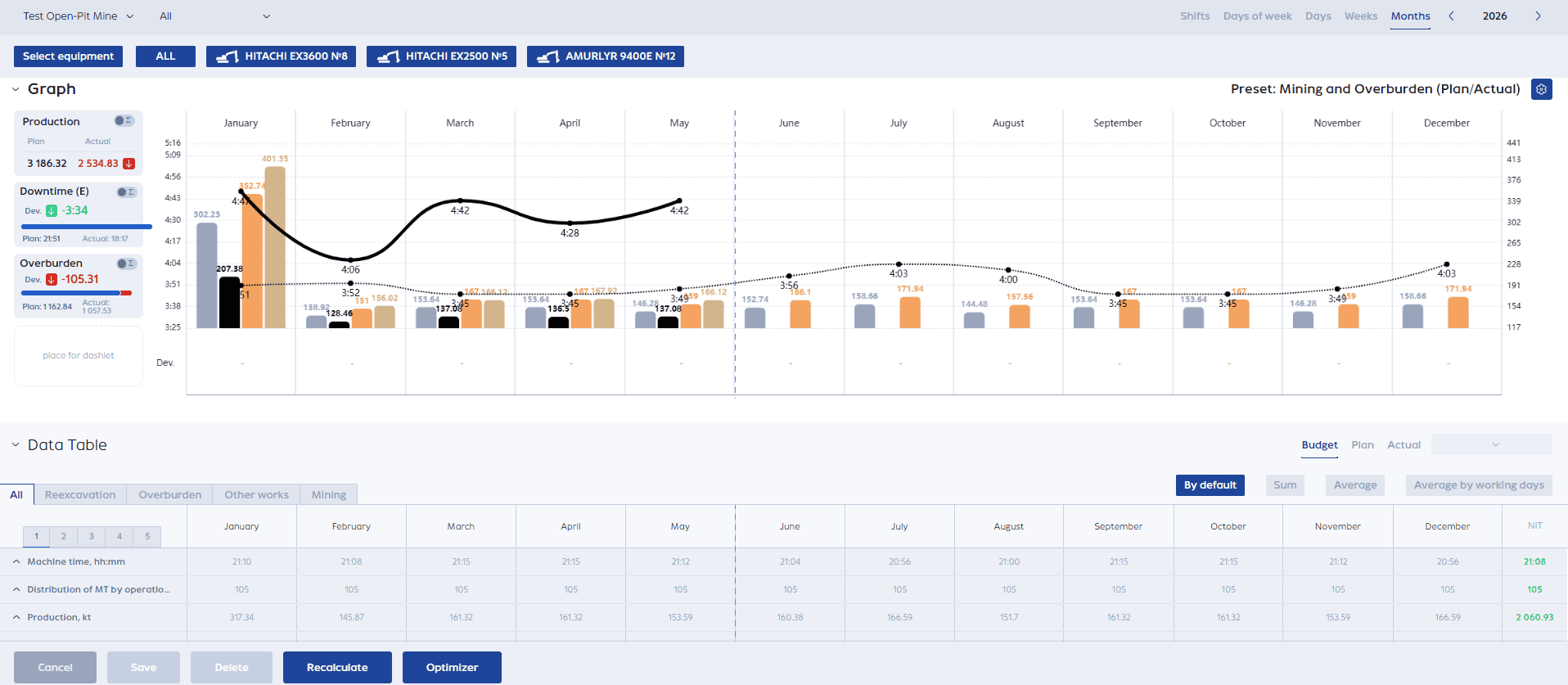
Enter key parameters — the system builds the plan. It is enough to set planned downtime by type (maintenance, electrical, mechanical, ancillary), UF and TAF coefficients, hourly productivity by work type, and haul distance — and the system will automatically calculate machine time, excavation and hauling volumes, and fleet utilization for each month of the year.
Monthly values are automatically broken down into daily values. The entered monthly value is distributed across days automatically — evenly for cumulative metrics or by working days for averages. There is no need to manually fill in each row for each day.
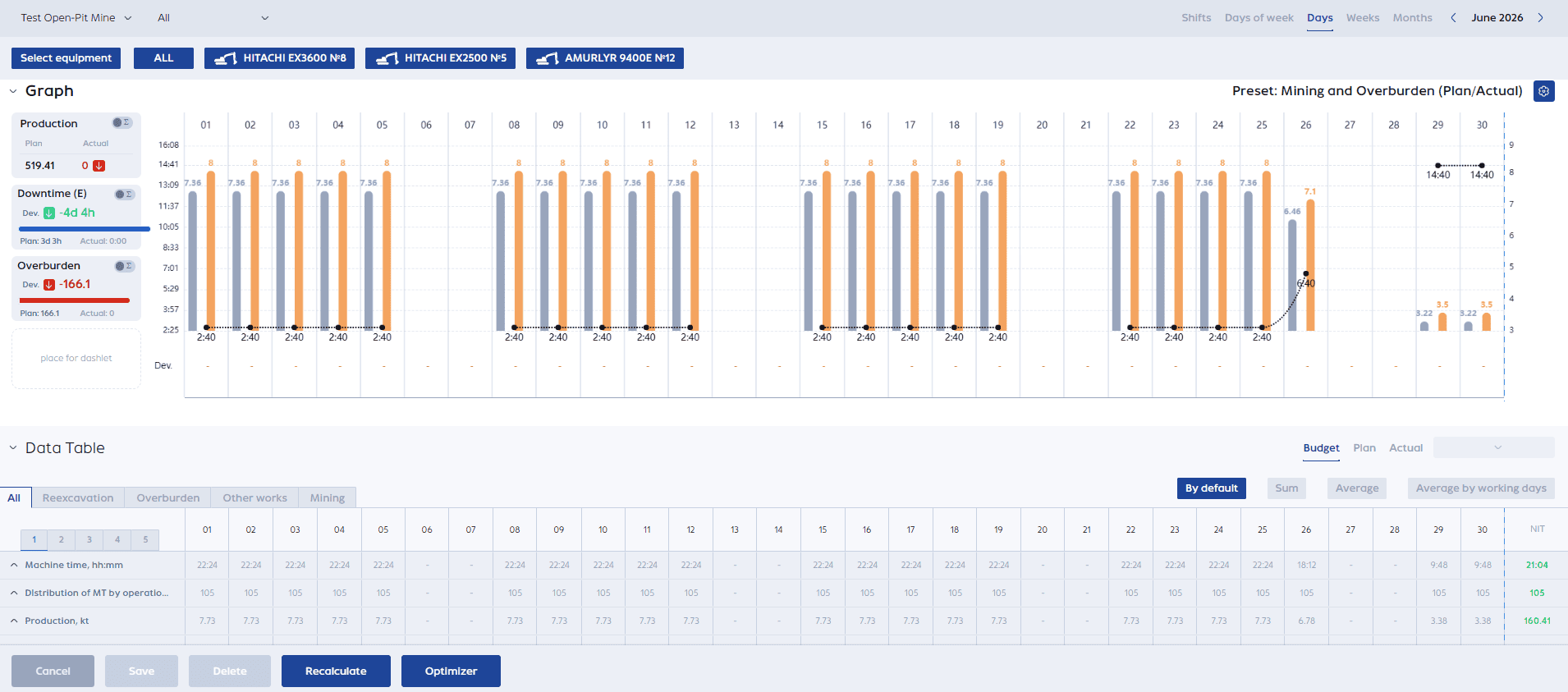
Change one thing — everything is recalculated. This is perhaps the most important feature. If you adjust the planned maintenance for an excavator, machine time is automatically recalculated, then excavation volume, then haul truck requirements, and finally the total rock mass for the year. The entire chain of dependencies works on its own.
Factor Analysis: Why the Plan Didn’t Match the Actuals
An annual plan without a deviation monitoring system is only half the job. PLANGR includes a plan-factor analysis screen that allows any discrepancy to be broken down into its components.
Instead of a simple “plan minus actuals,” the system shows exactly what caused the deviation: where increased downtime played a role, where productivity dropped, where the haul distance changed. You can drill down through the metrics tree — from the total rock mass to a specific work type.
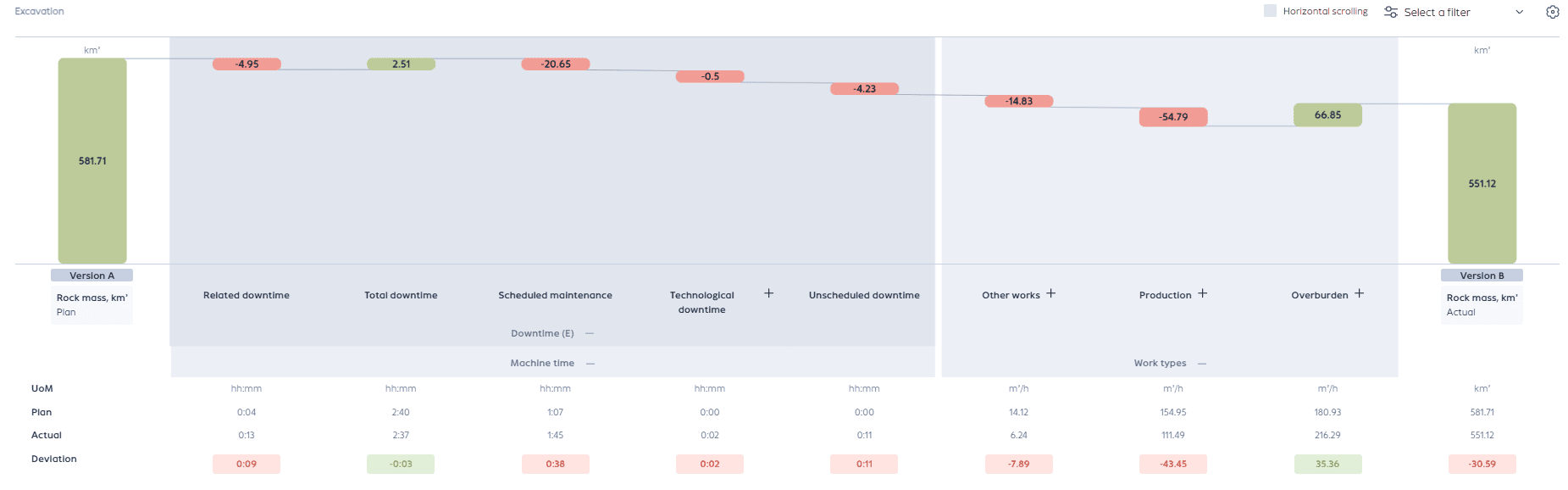
This changes the nature of the operational briefing. Instead of “why was the plan not met,” the conversation turns to “which factor contributed what percentage of the deviation and what to do about it.”
Reference Data: A Foundation That Does Not Need to Be Rebuilt Every Year
A good annual plan relies on up-to-date standards. PLANGR provides a reference data system for this: equipment with its technical parameters, work calendars, shifts, work locations, and downtime structure.
The base structure of the reference data is set up by an administrator for a specific enterprise. After that, users populate it with data themselves — adding equipment, configuring blast schedules, setting distances to shipment points.
Once configured, the reference data serves all subsequent planning cycles. There is no need to re-collect source data from scratch every December.
The Bottom Line
Developing an annual plan for OPM is a task that requires not just a spreadsheet, but a tool capable of keeping all the math up to date under constantly changing conditions.
The annual plan ceases to be a document that gets filed away after approval. It becomes a working tool that is used every day.